
The template library recently moved into a stage that is easy to misread: it now has more than 500 templates. The number itself is not the interesting part. What matters is that the new templates are not the same business email recolored and placed in a different folder.
Each of the three product languages now has more than 500 published templates. The work that took time sits in four series (Amber Workbench, Lilac Paper, Deep Navy Ledger, Sage Studio), each covering six to eight situations. They exist for one recurring problem: change the recipient, and the same sentence stops working.
Why small businesses need their own email scenarios
The emails sent by an independent consultant, freelancer, or small team are rarely complicated enough to justify a full workflow system. They still matter. A signed contract needs a clear confirmation. A quote needs a follow-up. An overdue invoice needs a reminder that does not damage the relationship. A satisfied client may be willing to make an introduction, but the request has to leave room for a polite no.
The hard part is not fitting facts into a message. It is keeping the relationship intact. A payment reminder should not sound like collections. A complaint response should not begin with an explanation of why the company is not at fault. A referral request should not read like a mass-marketing campaign. The template has to start with the person-to-person situation before it adds cards, buttons, and signatures.
Why one scenario needs several versions
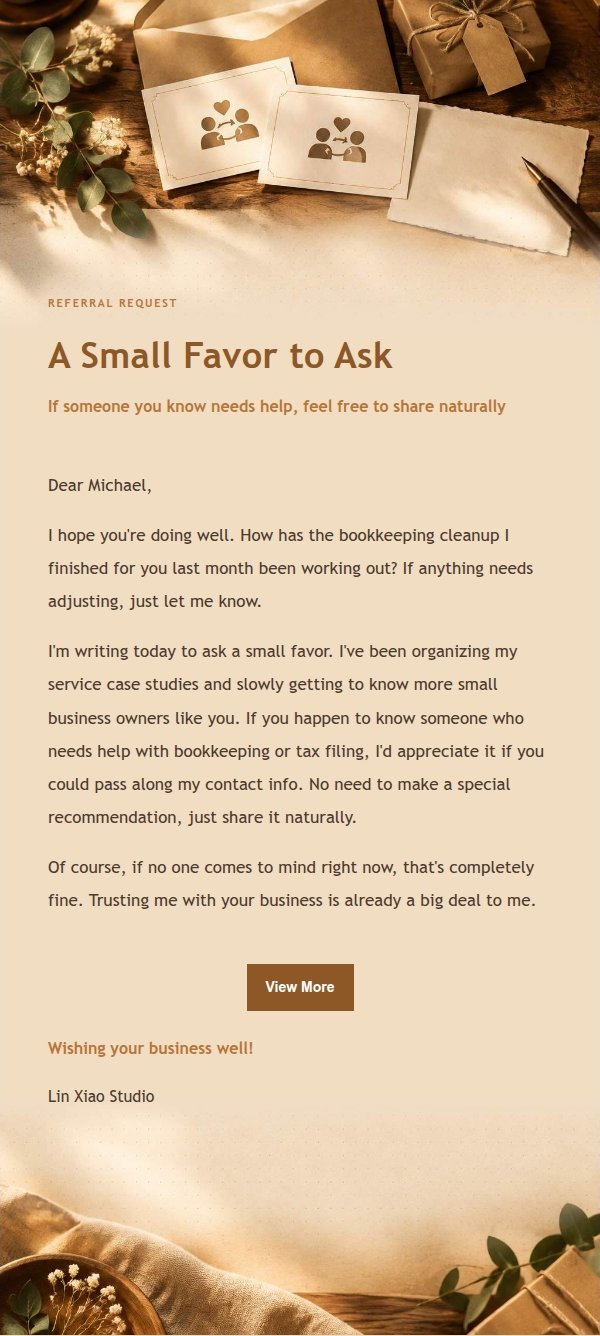
Take referral requests. The Chinese library has “琥珀工作台转介绍请求邮件.” The English record is “Amber Workbench Referral Request Email,” and the Spanish one is “Solicitud de Referidos Estilo Taller Ámbar.” These are not one image with translated labels. Each language has its own email copy and preview image.
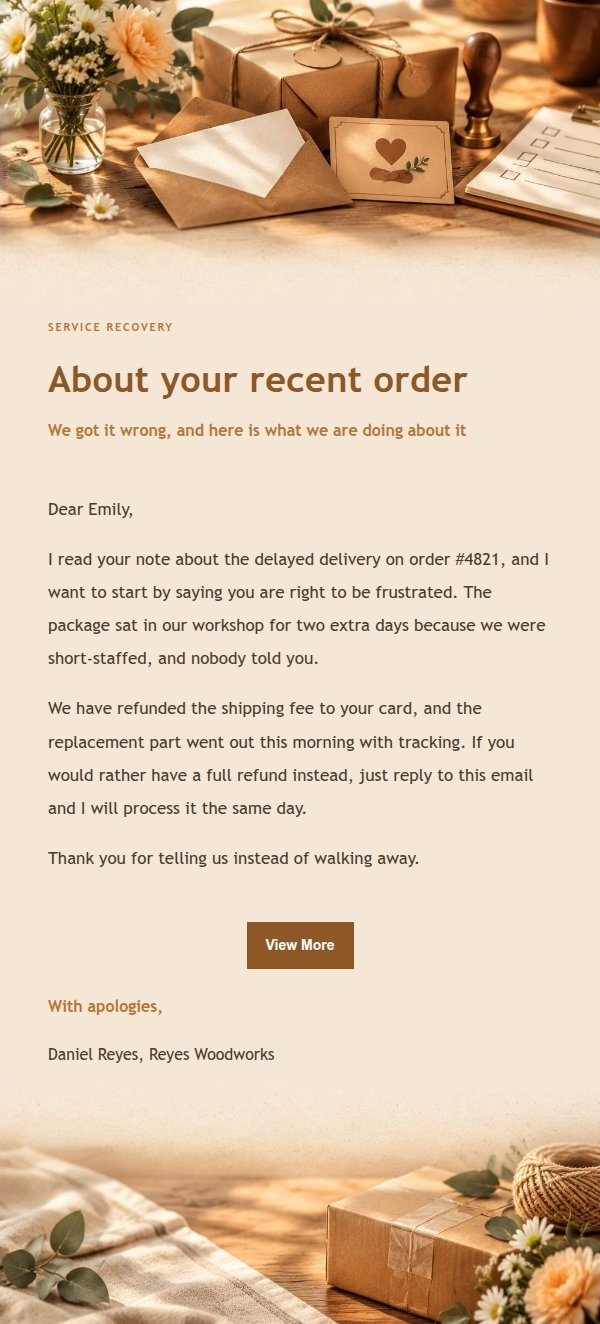
Complaint handling works the same way. The Chinese, English, and Spanish records have different names and different rendered previews. A reader is not looking at an abstract “complaint template.” They are looking at a message that handles the greeting, apology, resolution, and next step in the language they will actually send.
Which emails deserve repeated editing
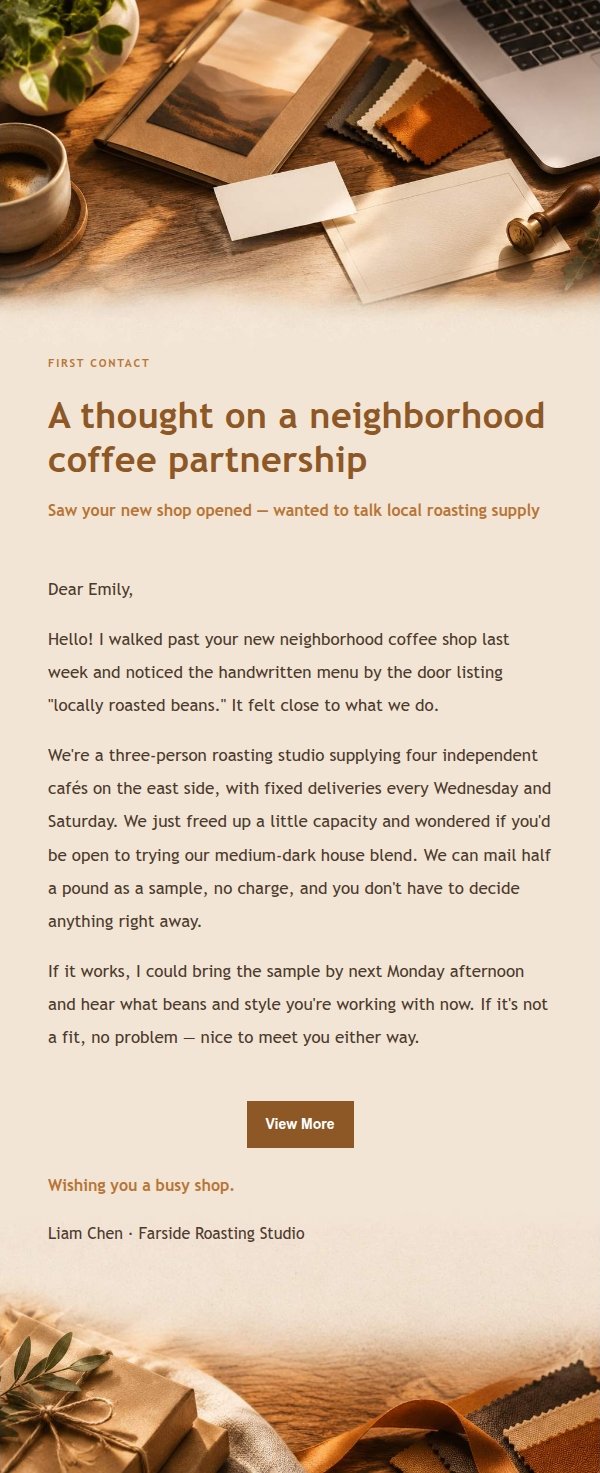
Payment reminders are one example. A useful version has to include the due date, amount, payment route, and a dignified way for the recipient to say that payment has already been made. Cold outreach is another. The first message should not introduce every service. It needs a low-friction reason to reply.
Referral requests are especially sensitive. A client can be happy with the work and still not want to introduce someone immediately. Phrases such as “if someone suitable comes to mind” and “there is no pressure if the timing is not right” are not empty politeness. They protect the relationship. We keep revising them because they determine whether the message feels like a request or an assignment.
Quantity is not the only measure of progress
Once a library passes 500 templates, adding more can become automatic. We care more about what happens when someone says, “I need to remind a client about payment without sounding harsh.” Can the system find a useful direction? Can the reader understand the relationship and purpose from the detail view? After generation, can the layout and wording survive a careful human review?
The library will keep growing. We are also continuing to look for real email needs and situations, especially the ones that appear repeatedly but are not covered well by the current set. If you have a situation and cannot find a suitable template in the tool, send it through the in-product feedback channel. We can use that signal to design and add a matching template.
What a useful template has to earn
A template earns its place by helping with a decision, not by filling another slot in a catalogue. For a payment reminder, that decision may be how direct the first sentence should be. For a referral request, it may be whether the sender gives the client an easy way to decline. For a complaint response, it may be when to acknowledge the inconvenience before explaining the fix.
Those decisions are easy to miss when a library is judged only by screenshots. A polished preview can still contain a vague subject line or a call to action that asks for too much. We try to look at the message as a recipient would. What do I understand after the first paragraph? Do I know what the sender needs from me? Can I answer without starting another round of questions?
The visual layer matters, but it follows the message. A card, button, or accent color can help a reader scan the email. It cannot repair a missing amount, an unclear deadline, or a greeting that does not fit the relationship. This is why the template detail view and the generated email need to be considered together. The user should be able to inspect both the design and the words before sending.
Small businesses often have less room for an awkward message. The person writing the email may also be the person delivering the work, collecting the payment, and answering the complaint. A useful template respects that reality. It saves time without pretending that every relationship can be reduced to the same script.
Frequently asked questions
Does a larger library automatically make recommendations better?
No. Quantity helps, but scenario tags, language, relationship, and the user’s own choice all matter.
Are the three language versions the same image with translated text?
No. Chinese, English, and Spanish use their own template records and rendered previews. A Chinese image should not stand in for another language.
If you are comparing email template tools, start with our email template collection and guide to choosing an AI email tool, then open EasyAImail to inspect the current templates.