
Some emails are grammatically correct and still sound as if an AI wrote them. The problem is usually not the sentence structure. It is that every sentence is polite while adding very little information.
EasyAImail has a specific writing-style section for this problem. It rejects hollow phrases such as “deep communication,” “create more value together,” and “heartfelt,” as well as mechanical connectors such as “First, Second, Finally, In conclusion.” These phrases are not always wrong. They are often used to hide the fact that the email does not say anything concrete.
This does not require users to add “remove the AI flavor” to every request. The writing method already includes prompts dedicated to removing those traces. Hollow courtesy, mechanical connectors, and overly symmetrical sentences are part of the built-in review instead of an extra instruction the user has to remember.
Vague is not the same as professional
“Thank you for your attention. We look forward to deep communication.” The sentence sounds complete, but the recipient still does not know what happens next. “If Thursday morning works for you, let us confirm the final two contract points in Meeting Room 3” gives the message a real action.
This does not mean every email should sound casual. A message to a client, manager, or partner still needs the right greeting and a respectful close. Courtesy should carry the information. It should not replace it.
Why the tidy three-paragraph pattern gives itself away
AI often gives every paragraph the same shape: explain the background, express appreciation, and state a hope. After a few paragraphs, the reader feels that each section is performing the same move. People do not always write that neatly. One point may need a single sentence. Another may need a date, amount, or next step in a list.
That is why our internal guidance asks writers to vary paragraph length, state the purpose early, and stop naturally. “Thursday at 10 a.m., Meeting Room 3” is more useful than “we will arrange a time,” and it is easier for a human to verify.
Replace “more value” with a checkable action
A practical editing trick is to question abstract nouns. What should the recipient do next? “Move the partnership forward” can become “Please confirm the delivery date on page 2 of the quote by Friday.” “Improve the experience” can become “Use the recipient’s name instead of ‘Dear customer’.”
Concrete information is not always a number. It can also be a relationship, a boundary, or a choice. “If this week is inconvenient, you do not need to reply; I can follow up next week” tells the recipient how to respond. “We look forward to your positive feedback” does not.
What a tool can and cannot do
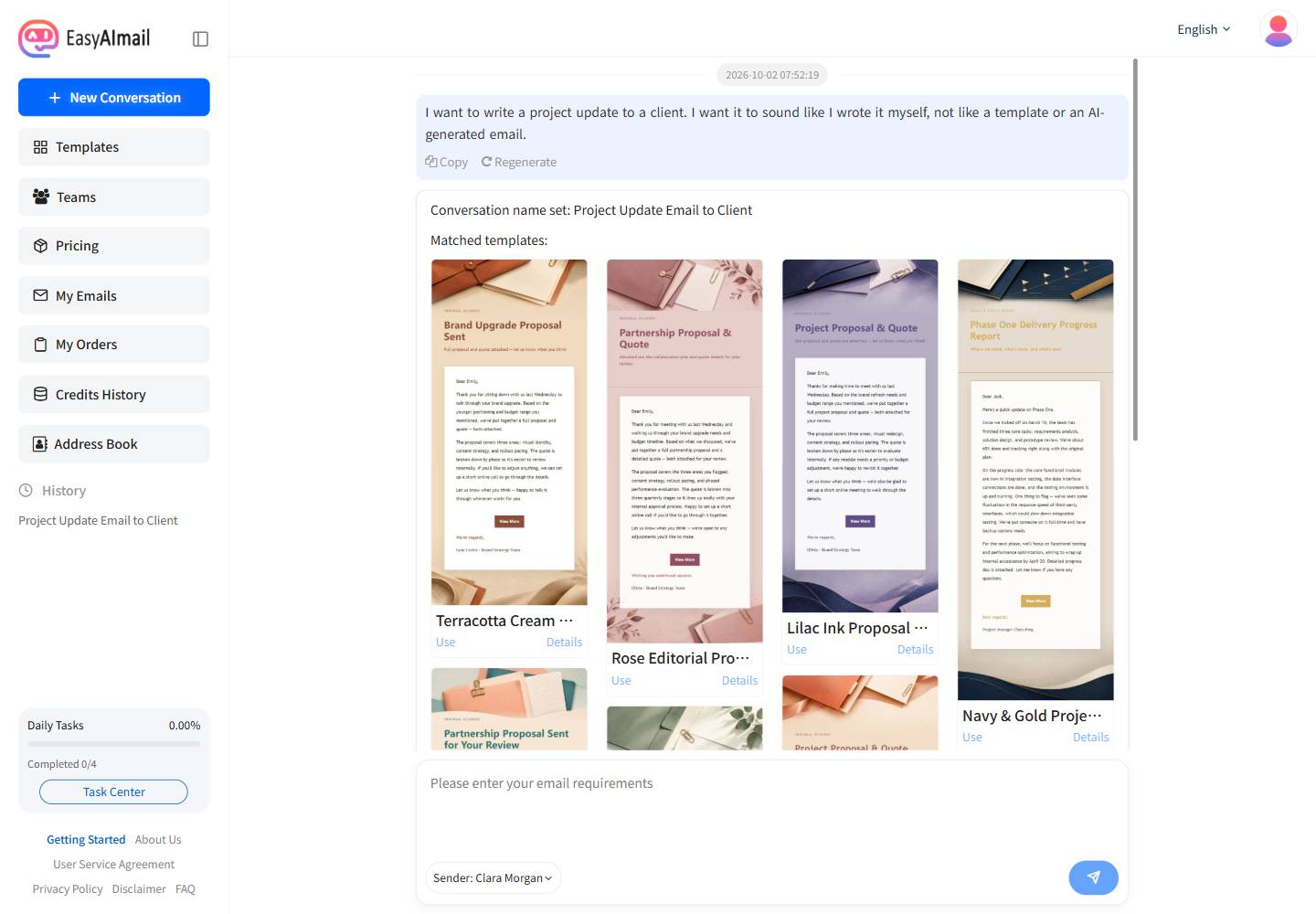
EasyAImail can recommend a template from a short intention and ask for missing details through a conversation. It can turn scattered context into an email structure. It cannot know a fact you did not provide, and it cannot decide whether a sentence fits the relationship.
You still need to check the recipient, salutation, dates, amounts, links, and tone after generation. The value of the tool is not skipping review. It is moving review from “I have no idea what to write” to “I know what needs checking.”
Read the email as the recipient’s next step
When I review a draft, I try to replace “What am I trying to express?” with “What can the other person do after reading this?” If the answer is only “understand that I care about this,” the message is probably still missing something. The attachment name, reply deadline, available options, and what happens if the timing is bad all give the recipient room to act.
This is also why concrete writing does not have to be cold. You can begin with thanks and still add the facts and choices that make the message useful. Courtesy keeps the relationship comfortable. Facts keep the work moving. Both belong in a good email, but neither can stand in for the other.
Choose a tone or describe one yourself
When writing an email, users can choose a formal tone for managers, clients, and other business contacts, or a friendly tone for colleagues and friends. They can also describe a different tone directly, such as classical Chinese, playful, or academic. Tone is not a single professionalism slider. It depends on the recipient, the relationship, and the situation together.
A short review routine that catches most of the traces
First, remove sentences that could appear in almost any email. If a line would fit a sales follow-up, a project update, and a complaint response without changing a word, it may be too general. Replace it with the detail that belongs to this recipient and this moment.
Next, look for repeated promises. “We are committed to,” “we value,” and “we look forward to” can be useful once. Several of them in a row create the sound of a brochure. Keep the one that carries a real relationship signal and use the space for a date, a decision, or a clear request.
Finally, read the message aloud at normal speed. The stiffest sentence often reveals itself through rhythm before it reveals itself through grammar. A paragraph that has three identical openings may need a new order. A long sentence carrying four requests may need a list. The goal is not to make the email casual. It is to make the work inside it visible.
One last check is surprisingly simple: remove the product name and read the email again. If the message still explains a real situation, asks for something specific, and gives the recipient a reasonable way to respond, the writing is doing its job. The tool can support that process, but it should never become the subject of the email.
Frequently asked questions
Do formal emails need lots of polite filler?
No. Keep the appropriate greeting and close, then prioritize the facts, request, and next step.
How can I tell whether a sentence contains information?
Ask what the reader knows or can do after reading it. If the answer is neither, the sentence may only be filling space.
For more on how email tools handle structure and templates, read why HTML email breaks in Outlook and our guide to choosing an AI email tool, then open EasyAImail and start with a real email intention.